
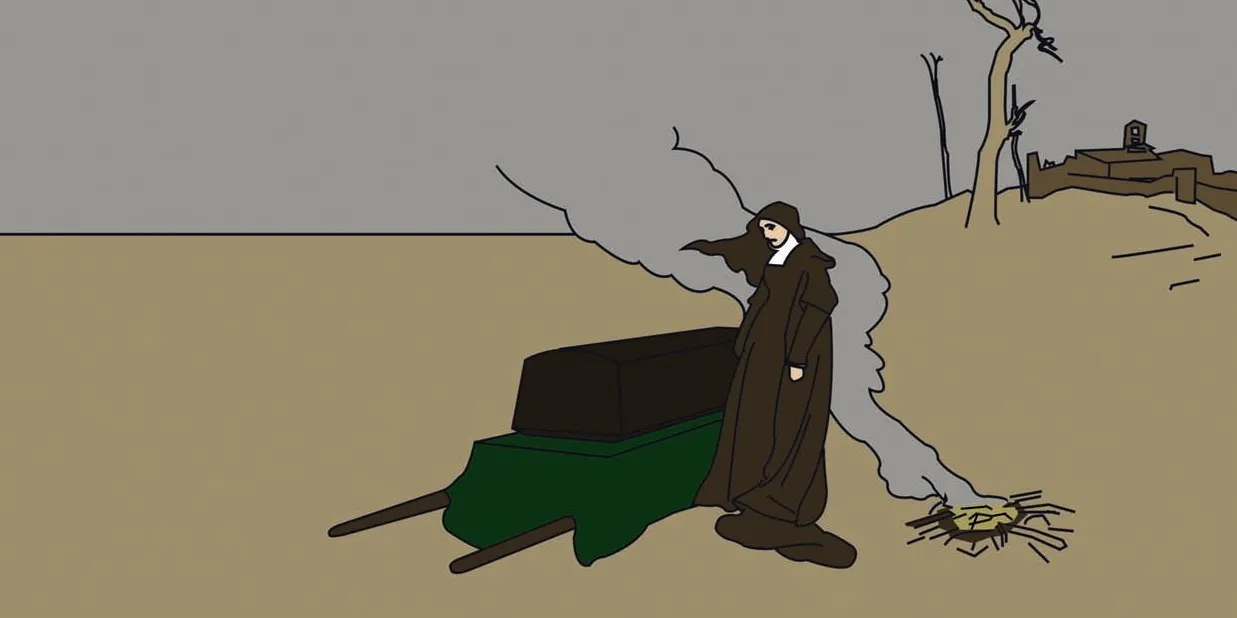


Hoy le pregunté a Patricia sobre el nuevo capítulo de su serie “Folklore”. Por lo que entendí, creo que trata sobre una posible maldición que relaciona a Juana la Loca con el desarrollo de Nueva Galicia, México.
Hablamos sobre Galicia, la vieja; su arquitectura, los estereotipos de siempre, el tiempo. Y sobre la nueva, la que una vez estuvo conectada por un vuelo directo a París. Dice que un par de veces ha estado de vacaciones en la vieja, y que en la nueva ha vivido un año durante los últimos cinco.
Al enterarse de que había sido Juana la Loca la que dio el nombre de Nueva Galicia a ese territorio mexicano, pensó que ésa podía ser la explicación para muchas cosas que le habían llamado la atención. Es como si fuese inevitable que realizara este trabajo. Siempre hace igual, intentar entender algo aprovechando cualquier dato que se le cruza en el camino. El resultado es querer explicar esas conexiones que parecen tener tanto sentido, y que dan pie a unas narraciones aparentemente educativas, aun teniendo mucho de surrealistas.
VOZ 1
This is a view of the sea from one of the world’s Land’s Ends.
Below these lines is the land.
In these kinds of lands, people go to carry out different rituals. Mostly they relate
to marking ending and beginning moments in their lives.
It seems to be that by coming to a geographical end it is easier to mark
a psychological beginning.
But this region was once also granted a new beginning. It was given its
“right to fly”.
Here the air right is a section in the contract when you buy a house.
It determines how much your house is allowed to grow, how much you
can add to it.
It gives hope for a prosperous future.
Always the second floor can be larger than the ground floor.
All the architecture in this region is dictated by this.
And perhaps also the character of its owners.
In one house in the town there were several tiles depicting waiting scenes
by the sea; a woman, a sailor, a grandfather with grandson.
Waiting to leave, or for someone to return, or for news, the typical things in
emigrant peoples. There is as much wanting in waiting as waiting in wanting.
But a region that has a place called Land’s End that is granted a new beginning
by a supposed insane queen would seem predestined to a difficult future.
VOZ 2
I come from the place that is the new version of this one.
I came to see what the original one is like.
I had heard about the houses with “the right to fly”.
I didn’t expect that it would be so obvious from their facades.
It seems that the additions are made to be noticed, as if to clearly say how much
have the houses´ inhabitants progressed.
Where I come from there are areas that have houses that may look similar, but
really they are very different. There nothing is finished. As if the owners couldn’t
believe in their own progress. Being the “New” something is a big weight.
We went to the Land’s End. Just to see where we began.
When we arrived it was cloudy and there weren’t so many people, later the
sun came out. Buses arrived, couples on their wedding day, people burning
their belongings, others by themselves were writing in the pocketbooks looking
at the horizon. It would be nice to be able to read all those writings together.
We stayed for a while.
I bought a ship from the souvenir tables, it looks like the one on the tiles from
that house. Not like a ship to sail but to wait for.
On one of the tables, among all the Gallego superstitious souvenirs, there was
a golden pyramid. An Aztec pyramid I thought.
It seemed to be there for me, to prove that the connection between the two
lands was strong and could be found anywhere.
I thought of how they build their houses here and if their progress continued
and the laws permitted perhaps each level would be bigger than the previous
and then all the houses would end up looking like inverted Aztec pyramids.